Showing posts with label grass. Show all posts

Thursday, September 5, 2013

What's up, Supina?

Ok, so I've been focused on the front lawn and haven't said much about the backyard in some time. That's because I don't have a clue what's going on back there, but it sure doesn't look good and it seems to only be getting worse. The following photos show the progression.

Here are some shots from 7/26:


A closer shot of a patch that appears to be dying

And some from 9/1:


It's not a pretty sight. I just wish I knew what was wrong.

This is what I do "know":

  1. It doesn't appear to be a fertilization issue. Not long after the first set of shots from July I gave some fertilizer to two small areas of the lawn and it didn't seem to make any difference.
  2. I've also been keeping it well irrigated, watering roughly every other day or so. That said, we haven't had much rain since late June.
  3. The summer hasn't been particularly hot (unlike last summer). There was a hot stretch in mid-July (7/14 - 7/19) with highs in the low 90s, and also the end of August (8/19 - 8/31).
  4. There are some areas that seem to be fairing better than others - why?
  5. From what I can tell (which is next to nothing), it doesn't appear to be a disease.
My best theory at this point is that it's simply the heat since supina bluegrass doesn't like it hot. This theory will soon be tested as fall arrives, at which point I'm very much hoping it will spring back to life. At this point since I don't have a clue what to do about it, I'm just going to wait it out and see what happens.

I think it goes without saying that my "experiment" idea is off for this year, which is just as well since I'd barely have the time for such a project.

Tuesday, September 3, 2013

Lawn surgery

Hot off the heels of the last application of Tenacity, since most of the creeping bentgrass is now dead (or at least appears to be dead) I didn't want to waste any time since this is the ideal time (for central Indiana) to plant grass seed. But before I did, I wanted to make sure that it's ok to plant so soon after spraying. I found an FAQ page with these questions and answers:
On which grasses has Tenacity been tested for use at or prior to seeding?
Tenacity is safe for use at or prior to seeding on Kentucky bluegrass, tall fescue, perennial ryegrass, and centipedegrass. Application at seeding can be made to fine fescue only if it is less than 20% of a seed mixture.
What are some of the unique benefits of Tenacity herbicide?
Tenacity has pre- and post-emergence activity on 46 dicot and monocot weed species. It can selectively control perennial monocots such as bentgrass and nimblewill and annuals such as crabgrass and goosegrass in many turfgrass species. Tenacity can be applied at the seeding to prevent weed germination and allow the turfgrass species to establish without weed competition.
I remember reading that, but I had to double check because it just seemed so counter-intuitive seeing as it turns mature Kentucky bluegrass tip white, so you'd think that young grass would be even weaker and more susceptible. Apparently not, which is fine by me!

I went ahead with planting some seed on Monday (9/2).

For this project I ended up using up a bunch of remaining stuff I had on the garage from previous years: some Scott's starter fertilizer, a bit of GreenView Grass Seed Accelerator (left over from this project), and hesitantly/fearfully the seed I used for last years reseeding. The other stuff should be fine, but the seed had a sell by date of 4/13 and of course is over a year old. I did a search online regarding the use of expired seed and the (completely unofficial) general consensus I gathered is that most of the seed should be fine as long as it was stored properly (e.g. not exposed to moisture), but to expect germination rates to be be lower (more so the older it is). As I often tend to do, I decided to take the risk, but put down more seed than I normally would to hopefully compensate. If 25% of the seed germinates, I'll be happy. We shall see.

Also "reused" in this project was the dead carcasses of the dead creeping bentgrass in lieu of straw or some other mulch, because I 1) didn't have enough of the Greenview Grass Seed Accelerator left, 2) didn't have any other mulch, and 3) was lazy and didn't feel like going to the store and buying any (I firmly believe that laziness is a prime fuel for creativity). In most places the bentgrass was pretty thick, so it just makes sense to me to use it, plus it made the project easier and cheaper - win, win... maybe?

So I used my manual tiller to loosen up the soil underneath the dead bentgrass and the pulled it back to reveal the soil below as seen in the following photos:


After this, I generously dispensed some seed into the soil using a handheld spreader, and then added some starter fertilizer also using the handheld spreader. Then I mixed it all up a bit into the top layer of the soil, covered it back up with the dead bentgrass clumps, and finally matted it down a bit by walking on a board I laid over top of each area. After which, the finished product looked like this (not much different than before!):


In some areas where there was more soil exposed, I put down
some of the GreenView Grass Seed Accelerator
In addition to the bentgrass areas, I also seeded some other areas that seemed to have died this summer (apparently I didn't irrigate enough!).

North side of the driveway (after tilling)
By the road (after tilling).
By the road (after seeding).
Closer shot of the previous.
As usual, I now anxiously await germination - which I hope does in fact happen! In the meantime I'll be irrigating to keep the soil moist.

I just can't seem to go a year without reseeding - maybe next year!

I'll report back upon germination, or lack thereof.

Thursday, June 20, 2013

Creeping bentgrass... confirmed?

So I did some sleuthing and to the best of my grass identification skills (which admittedly are extremely poor), I believe I have successfully identified the front lawn turf invader to be creeping bentgrass. It has really grown quite a bit since a year ago and continues to spread. Something must be done. But before I get to that, here's how I went about identifying it.

I went off of my initial guess made last year as a starting point and searched for how to identify creeping bentgrass. This led me to this very useful and informative site from North Carolina State University's TurfFiles which has a profile page for creeping bentgrass describing it's various plant characteristics, including photos.

This led me out into the lawn with my macro lens to see if I could gets some photos of these key plant parts to help identify it and hopefully confirm or deny the identity by comparing with this site.
I was only able to get photos of some of parts as I didn't have much time. However, after inspecting the plant a bit and the photos compared with the TurfFiles photos it already looked like a match to me, but I'll get to that in a sec.

I also remembered a handy tool for identifying grass that I had tinkered with from Purdue University in the past. This tool helps to narrow down an identification based on some of the plant characteristics: vernation, ligule, auricles, leaf tip, leaf surface, mid-rib, collar, growth, and seedhead. I'm certainly still learning about these little plant details (never would have guessed that there'd be so many parts to grass), but I found the tufgrass identification guide linked from the tool to be a good introduction. Using this tool, I entered the characteristics that I was the most certain about (and by certain, I mean not at all certain):
  1. Membranous ligule
  2. Absent Auricles
  3. Pointed leaf tip
At this point the tool had already filtered the possible contenders with a 100% match to just two: creeping bentgrass and colonial bentgrass. Additionally, I entered the leaf surface as ridged, but this didn't change anything as they both have that as well (and it turns out all but growth habit are the same between the two). Here are my photos that show these things:

A bit of a plant that I pulled

Shows the logn membranous ligule (the white
part) and the lack of auricles

After pulling back the blade
Rotated and even closer.

The blade tip pointed (the boat-shaped tip of a blade of kentucky bluegrass can
also be seen to the right)
So, the next step is to discern between colonial and creeping bentgrass. The nice thing about the tool is that you can view photographs of each of the parts for each specific type of grass, in addition to more specific information about it. It further states that colonial bentgrass has a short membranous ligule, while creeping bentgrass has a long ligule, with photos showing each. So even without knowing anything else other than these 3 or 4 attributes, the long ligule distinguishes the two.

But there's more. For colonial bentgrass it states:
"Technically possesses rhizomes and stolons they are generally absent and this species assumes a bunch-type growth habit."
 And creeping bentgrass:
"Bluish-green color, very fine leaf texture, tall membranous ligule, tolerates close 1/2 inch. Leaves may appear slightly rough along the edges, strongly stoloniferous."
So furthermore the two can be distinguished by their growth habits. One of the first things I noticed about the grass when I saw it was how it appeared to grow "horizontally" (likely via stolons, but I've yet to confirm this). It doesn't sound like colonial bentgrass would grow like this.

So there you have it: a positive identification... ?

Assuming so (and I feel confidently enough), the next step is to take action; and Tenacity herbicide sounds like the best available option. More to come.

Tuesday, May 14, 2013

Backyard Lawn Update

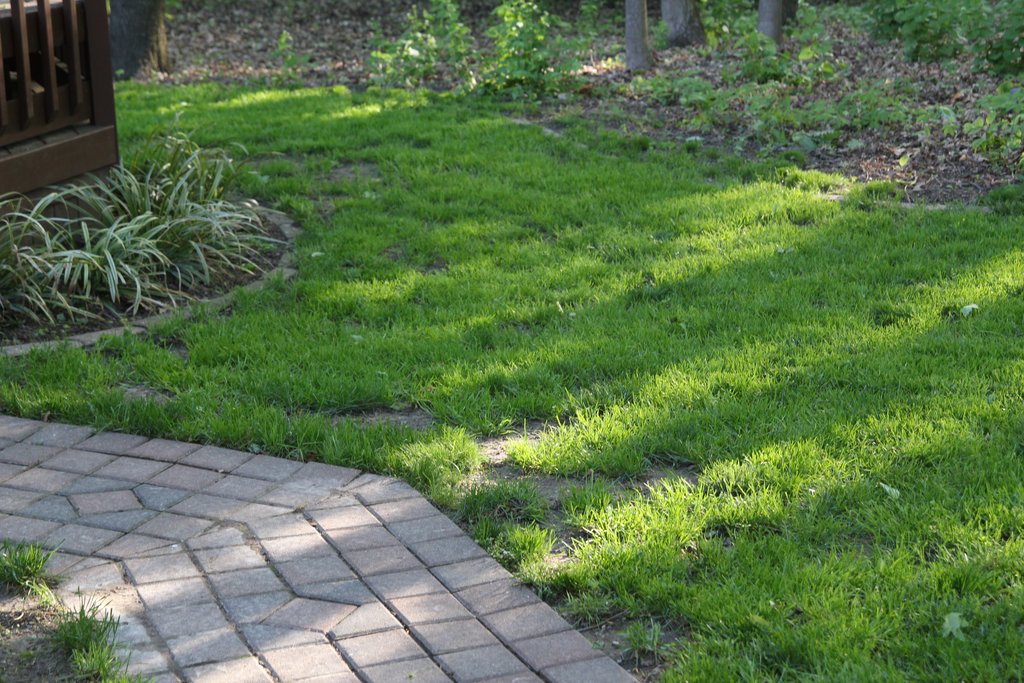
I covered the front lawn in my previous post, now on to the backyard. Considering how the lawn looked after last year, I had no idea what to expect this spring, but my expectations where low. Well, I must say that I'm impressed! Still far from perfect, it's at least somewhat beginning to look like a lawn again!

I think this area will need some love this fall.

Another sparse area.

Kinda looks lawnish!


Utter barefoot bliss. This patch is the best!


Another area that needs some love.


I transplanted this patch by the brick in order to help
prevent erosion in this area during heavy rain. Need to
transplant some more.
And this is my favorite surprise. I noticed these little grasslings coming up in some of the bare areas throughout the lawn. While I'm not certain (yet), I think that these were actually from seed heads of the grass from when I mowed it last. It was seeding at the time and I wondered it it might be possible for those seeds to survive and germinate. I think some did!

New grasslings sprouting in a bare area!
Now that I'm aware I'm going to try to keep the lawn well watered and hope these little guys can survive the summer! I'll note that not all bare areas had so many sprouting, but I did see some in other areas of the lawn. It'll be interesting to see how things progress; perhaps there are more seeds that haven't germinated yet.