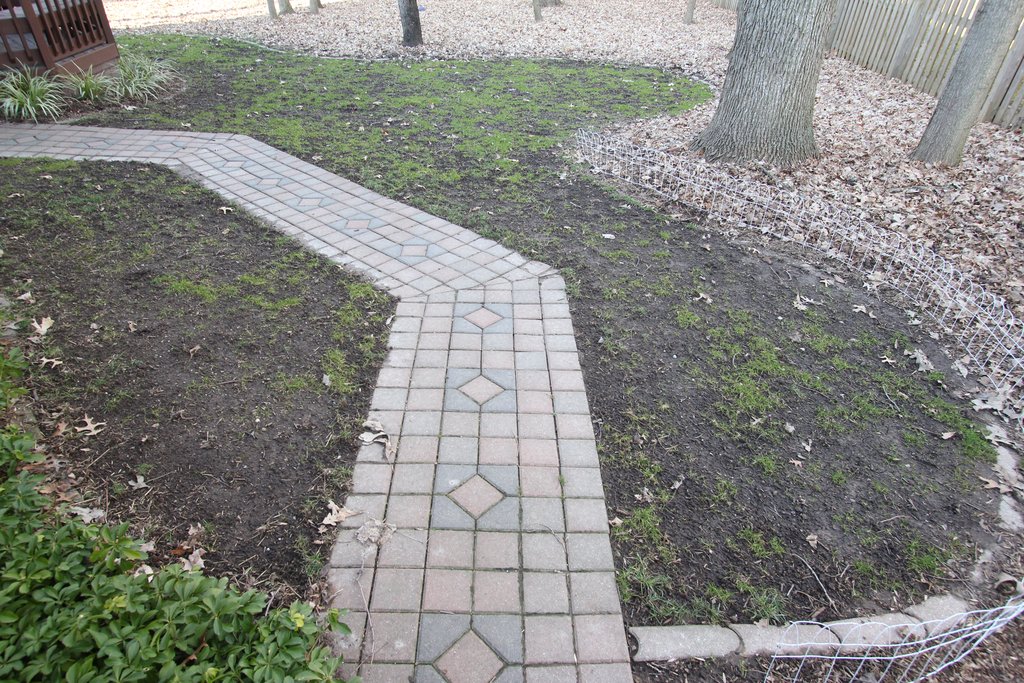
The supina bluegrass planted last year has been growing leaps and bounds. I'm starting to wonder if it will even have been worth it to have planted more seed this spring. I guess time will tell, but it seems that with each passing week, the bare spots fill in more and more. Here are some photos taken yesterday:
I have walked on it barefoot and it feels wonderful! The fine fescue that I planted only a few weeks ago also appears to be growing well:
And for the record: I never ended up putting any starter fertilizer down.
Showing posts with label fine fescue. Show all posts
Thursday, March 29, 2012
Wednesday, March 14, 2012
"Dormant" seeding again...
So, on somewhat of a whim a few weeks ago (March 5) I decided to put down some seed in the backyard - much like last year, only 2 weeks earlier, but ironically it's much warmer, so there's nothing dormant about it. Go figure.
I purchased the same seed as last year: SS6000 shade mix from SeedSuperStore.com, a 80% mix of 4 varieties of fine fescues (although 2 varieties are different from the batch I got last year) and 20% Bewitched Kentucky Bluegrass.
Unfortunately, I really didn't give the grass I planted last year much of a chance when I destroyed it with the overseeder last fall... but let's try to forget about that. New beginnings... again.
As soon as the seed arrived, I put it down. I didn't do any soil preparation hoping for some more below freezing temps to help expand and contract the soil and allow the seed get deeper into the ground. Yeah, I think there have been two nights of below freezing temps since then. One of which was the first night (one of the reasons that I wanted to get it down so quickly):
Otherwise it's been too warm for even below freezing nights, so due to rain in the forecast I decided to help work the seed in the ground in places where I could do so without harming the existing grass. I went to Lowes and purchased a hand tiller and tilled almost the whole lawn by hand. It took me over an hour, but I felt like I could sleep better knowing that the rain wouldn't wash or displace the seeds away as easily and it appears to have worked (granted the rain wasn't terribly heavy). It also should help the seed to germinate better (that was one of my mistakes last spring, not working the seed into the top layer of soil).
I then used the rest of the GreenView Grass Seed Accelerator that I leftover from the 2010 front yard project, but it wasn't enough so I picked some more up and put most of it down as well. This should also help with germination and hopefully help deter erosion (probably not as effectively as straw, though).
So far, I don't see any seeds germinating. I wouldn't expect it so soon anyway, but with the warm weather we've been having I wouldn't be surprised to see it either. This is how the backyard is looking as of yesterday:
And just for the record and comparison (because I think that the Poa Supina has already started greening up), these shots were from a few weeks earlier (February 27th):
Other than the small amount of fertilizer that is in the mulch, I haven't put down any starter fertilizer. I have some in the garage. Should I put some down??
I purchased the same seed as last year: SS6000 shade mix from SeedSuperStore.com, a 80% mix of 4 varieties of fine fescues (although 2 varieties are different from the batch I got last year) and 20% Bewitched Kentucky Bluegrass.
![]() |
| 19.96% Predator Hard Fescue 19.66% Zodiac Chewings Fescue 19.80% Garnet Creeping Red Fescue 19.85% Bewitched Kentucky Bluegrass 19.80% Intrigue2 Chewings Fescue |
As soon as the seed arrived, I put it down. I didn't do any soil preparation hoping for some more below freezing temps to help expand and contract the soil and allow the seed get deeper into the ground. Yeah, I think there have been two nights of below freezing temps since then. One of which was the first night (one of the reasons that I wanted to get it down so quickly):
![]() |
| Seed on frozen ground the next morning |
I then used the rest of the GreenView Grass Seed Accelerator that I leftover from the 2010 front yard project, but it wasn't enough so I picked some more up and put most of it down as well. This should also help with germination and hopefully help deter erosion (probably not as effectively as straw, though).
So far, I don't see any seeds germinating. I wouldn't expect it so soon anyway, but with the warm weather we've been having I wouldn't be surprised to see it either. This is how the backyard is looking as of yesterday:
And just for the record and comparison (because I think that the Poa Supina has already started greening up), these shots were from a few weeks earlier (February 27th):
Other than the small amount of fertilizer that is in the mulch, I haven't put down any starter fertilizer. I have some in the garage. Should I put some down??
Wednesday, August 10, 2011
The Grass Project III: The rest
I have been known to do some [unscientific] gardening experiments in my day. My approach to the experiments are simple: try it and see what happens. And also: if it fails, try something else. Well, here I am for some more fun. You just can't predict what I'm going to do next.
The Front Yard
My first foray into "lawn improvement" was definitely unconventional and experimental, littered with mistakes and shortcuts, but if you take a look at the lawn today, it's much improved and I'm fairly satisfied. I would call that a success in my book. However, the road to get there was rather long and difficult and I wouldn't prefer to do that over again. The problem I have to deal with now is that that project only replaced a portion of our front lawn leaving the rest in stark contrast. I tried to address the primary problem with the remaining grass (tall fescue) this spring and early summer with Certainty herbicide, but this didn't completely remedy the problem (although it was still a big improvement). And as mentioned, I have pulled quite a bit of the remaining tall fescue by hand. I'd say now that perhaps 1/5 of the lawn remains with a high population of tall fescue. Here is how the front lawn is looking as of yesterday (after a fresh mowing followed by bit of rain):
![]() |
| Other side of the driveway |
Here's an image showing the three different "zones":
Green = new grass planted last fall
Orange = old grass w/remaining tall fescue pulled by hand
Red = old grass with remaining tall fescue
![]() |
| Other side of the driveway |
The Green Zone...
This is the area I tore up last year and reseeded. This grass is doing fairly well and should hopefully recover from the heat and drought conditions we've had since the end of June. This area I merely plan to aerate and overseed.
The Orange Zone...
This is the original grass now mostly tall fescue free. There is some remaining undesirable grass, but I should be able to manage it by pulling or perhaps another round of Certainty if it comes to that. This grass is much more thinned out than the green zone and even has some completely grass-less patches. I plan on aerating this zone as well and perhaps tilling the soil a bit of more bare areas.
The Red Zone...
This is the bad zone - the areas that still have a fairly high population of undesirable grass, as well as being thin and patchy. There isn't much kentucky bluegrass to be found here. I plan to essentially reseed these areas with the first step being killing the existing grass, which I started this afternoon by spraying with Roundup. The next step is either aerate the living crap out of those areas or... till it all up. I don't know what's wrong with me, but I'm starting to think that this is the way to go for these areas. The main reasons are:
- Since this area will be mostly dead, I don't know if aerating will be enough. The Purdue guide says that aerating is only really an option when the soil isn't compacted and although I don't exactly know how to tell that, I would be surprised if it wasn't.
- Last year I didn't do the first step of killing the grass, so I had to sift through it all and pull it out which is what took FOREVER; this time I'd just leave the dead grass in.
- Last year I started out manually tilling by hand before finally renting a power tiller; this time I'd start out with the power tiller.
However, one con with this that after tilling the soil is supposed to be allowed to settle for a week or two with rain or irrigation - this adds time and I'm already getting behind...
So, what to do? I don't know. As usual, I'll play it by ear and keep you guessing. Of course, if you have any suggestions, I'm all ears. For now, I'll see how long it takes for the Roundup to kick in.
The Backyard
First of all, why is "front yard" two words, but "backyard" one?? That bugs me a bit. But what also bugs me is our backyard, literally. Earlier this spring, I tried planting some shade tolerant seed, and well, it flopped. It was "experimental" in that I didn't follow the suggested seeding guide very well. I didn't do much soil preparation other than some raking of the very top surface and I think this was the primary culprit. What happened is that early on before germination some very heavy rain occurred and since the soil under the thin layer of raking was more compacted, this allowed the seeds to be washed away or moved due to puddling. In addition, this compaction may have made it difficult for the seeds to grow deeper into the soil (of course, please keep in mind that I just said above that I don't know how to tell if it's compacted, so take all of this with a grain of salt). Furthermore, there are other struggles back there such as competition with the trees, both for light and water. And, the hot and dry weather that we've had likely only exacerbated the other problems.
Here's how it's looking as of yesterday:
Unfortunately, it really doesn't look much different from before I planted the new seed. So... naturally I'll be trying again. I think this time I'll try aerating with perhaps some additional soil preparation in the more bare areas. Also, I'll be trimming back the tress to let as much light in as possible.
Seed for both the front and backyard is in route. I'll have a post on that soon.
Here's how it's looking as of yesterday:
Unfortunately, it really doesn't look much different from before I planted the new seed. So... naturally I'll be trying again. I think this time I'll try aerating with perhaps some additional soil preparation in the more bare areas. Also, I'll be trimming back the tress to let as much light in as possible.
Seed for both the front and backyard is in route. I'll have a post on that soon.
Wednesday, June 1, 2011
Backyard grass: eh
Well, I'm just not too impressed with how the backyard grass project has turned out. And that's ok, it was more or less an experiment. But, also I haven't completely given up hope. I have read that fine fescue can be very slow to establish and I have also seen that first hand with the Kentucky bluegrass in the front yard project as it took all of last fall and this spring to become established.
My last update on the backyard grass was April 26th, so looking back you can sort of compare. I think there has definitely been improvement since then. Here are a few photos from today:
And some closeups:
It looking a lot better where the new seed took, but the problem is that there are many patches where the new seed didn't take at all resulting in completely bare patches. I wonder if one of the reasons that this may have occurred is because we got a lot of heavy rain before the seeds germinated as this may have moved the seeds from the more bare areas. I don't know, but it looks fairly green back there, and that's good enough for me (for now). We'll see if it continues to improve.
My last update on the backyard grass was April 26th, so looking back you can sort of compare. I think there has definitely been improvement since then. Here are a few photos from today:
And some closeups:
![]() |
| Fine fescue (patches) |
![]() |
| Fine fescue thickening up |
![]() |
| Kentucky bluegrass? More of this grass. |
It looking a lot better where the new seed took, but the problem is that there are many patches where the new seed didn't take at all resulting in completely bare patches. I wonder if one of the reasons that this may have occurred is because we got a lot of heavy rain before the seeds germinated as this may have moved the seeds from the more bare areas. I don't know, but it looks fairly green back there, and that's good enough for me (for now). We'll see if it continues to improve.
Subscribe to:
Posts (Atom)