Monday, June 10, 2013

Rose bush updates

I've got 3 issues with the rose bushes this year, so I'll address them each separately.

Aphids

The new rose bush intruder of 2013: aphids. I sprayed them a few times and haven't seen them since. Yay! 

Bristly Rose Slugs

Without fail, I spotted some leaf damage on both rose bushes (forget exactly when this was, sometime since May 15th, I guess); turned over the leaves to find my little wormy "friends" munching away. This year I didn't delay in spraying them with insecticidal soap. I did this a few times, and so far it seems to have worked very effectively as I haven't noticed any new damage. Seems that the key is to spray quickly as possible with these buggers!

Black Spot Disease

This is biggest question mark of this post. Last year I went and purchased some fungicide to treat the black spot disease on the hybrid tea rose bush. 

Daconil Fungicide


 I brought it home only to find that it should apparently be applied in the spring, at least I think that's what it's saying. The directions are horrible. Not only does it not say how to spray it on the plant or even what to spray (I assume they mean to spray the infected leaves?), but they give specific cryptic directions for rose bushes for the first application: "spring bud break". Um, what?

Spring bud break?
In any case, there is one flower in bloom right now (more buds on the way!), it's kind of spring - ok maybe a little late, but the black spot was spreading so a week or so ago I decided to just spray the infected leaves and see what happened. As far as I know nothing has really changed, but it doesn't seem like it has spread anymore either. I'm still monitoring, but this is what some of the leaves looked like as of a few days ago:


Hopefully it works because last year by the end of the season it hardly had any leaves left since they were all infected. It'd be nice to eradicate it for good somehow. I wish the instructions on the fungicide were better. I have no idea if I need to reapply or when or how or where.

Saturday, June 8, 2013

Backyard lawn update

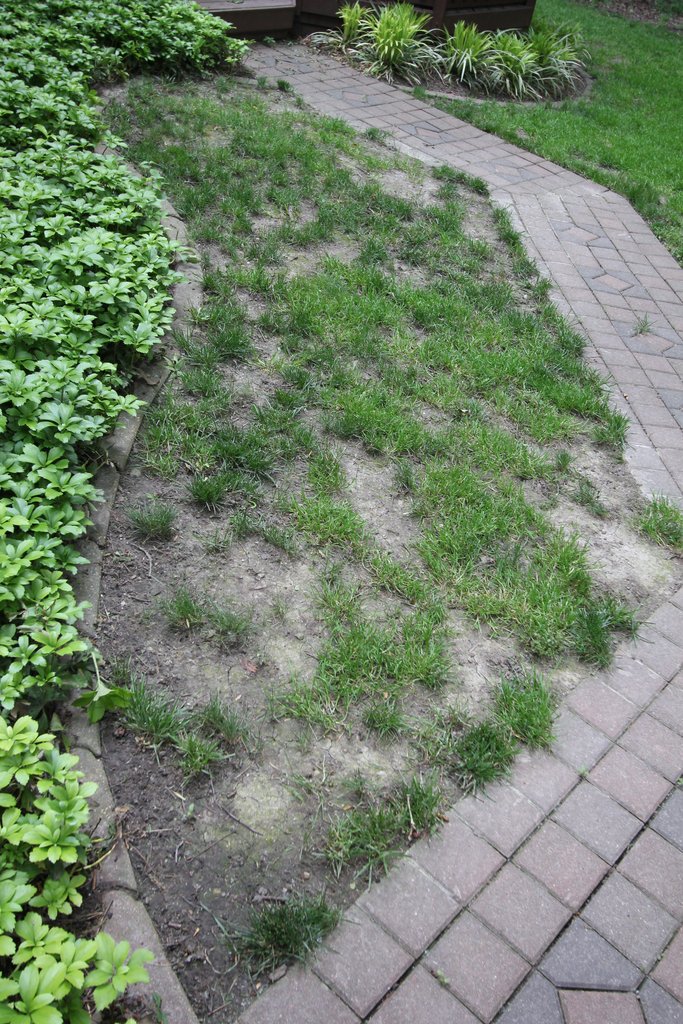
Not much to report in the backyard. It really hasn't changed a whole lot since my last update; there's still a ways to go. But considering how it looked at the end of last year, I'm content.

Here are some photos:


I'm wondering if perhaps it might want a little fertilizer?

I'm also thinking that I'll likely need to put down some seed this fall to fill in those very bare spots. Plus, of course, there's the "supina bluegrass experiment" that has been floating around in my head...

Front lawn update

The front lawn is really doing great. I've very satisfied with it and feel great about all the work I've put into it over the last few years.

Here are some photos:


Today I transplanted some grass growing into of the garden beds to some small bare spots in the lawn.

My one last (for now) issue is the patches of mysterious evil grass #3 (#1 being orchardgrass, #2 being tall fescue). You can see them clearly in the following photos as the lighter green patches:


I don't have an ID on this grass yet, but one possibility is creeping bentgrass. I took some closer photos last year.

I was thinking that I'd just spray it with Roundup and replant this fall. However, I was doing some searching and if it is in fact creeping bentgrass, I found that there is a selective herbicide (active ingredient mesotrione) that supposedly will kill it without harming kentucky bluegrass (among other turf grasses)! One product based on it is called Tenacity which it seems people are having good results with for killing bentgrass. But it also kills a number of other weeds including crabgrass! It's rather expensive (about $75 for an 8 oz bottle of concentrate) as these chemicals seem to be, however, if that means I wouldn't need to do pre-emergent crabgrass prevention every year, it could be just as cost effective if not cheaper to go this route.

However, I'm getting ahead of myself. The first step is to ID it. This is not my forte, but I'll try my best. Here's some information I found on how to ID it. I'll report back.

Front lawn fertilization

I put down some fertilizer this week. We've had a bunch of rain this spring (15" since April 1) and it's about time to put down the second half of the crabgrass preventer (~60 days ago, April 15). I put down the rest of the bag of Endure Crabgrass Preventer Plus I had, which came out to be about 3.8 lbs. Since we've had so much rain, I added an additional 1.2 lbs of Scotts 32-0-4 (5.7% slow release N). In some places the lawn wasn't looking as green, and there are some greener spots where I presume dogs had peed (this has worked before!). In hindsight, the 7.8  lbs total of crabgrass preventer was quite a bit more than I had put down in the past: 3.5 lbs for the entire application - whoops! I guess my own blog has failed me. Hopefully it doesn't turn out to be a problem. So far I've not seen any crabgrass. Total nitrogen comes out to about 0.7 lbs/1000 sq ft. So far it hasn't rained enough to water it in, but we're forecast to get some this weekend.

Sunday, May 19, 2013

A plant I can easily identify

I found a most unwelcome visitor in our yard this weekend:


(in focus behind the other plant)
Poison Ivy. Nasty stuff for those who are allergic, like me.

I have found poison ivy in and near our property before, but not very often (only 4-5 times in the several years since we moved in), so I don't frequently look out for it specifically.

This past week I got an itchy rash on my arm, feet, and leg - just small areas, nothing serious. I had no idea what caused it at the time, but it looked very similar to poison ivy rash that I'm all too familiar with from past encounters. Still it didn't make sense since I hadn't been out in the yard other than mowing.

But this morning I noticed the rather large poison ivy plant in the first photo above and that confirmed it for me. I went on the hunt for more and found several others throughout the yard. In our backyard, most of the yard is very shaded and instead of mulching we just leave the leaves that fall during the fall and more or less leave it as is. Throughout the year various weeds and plants inevitably grow here. I occasionally will spray them with Round Up when they get out of control, but I don't go crazy over it as it takes quite a bit of time and herbicide to spray them all. I'm not out in that part of the yard very often, but our dog is, and I presume that is how I was somehow exposed to it.

Years ago I got a pretty bad rash in places all over my body. I unknowingly got into some and likely got it on my shoes, then my hands and/or under my fingernails, and proceeded to spread it everywhere I touched. Needless to say it wasn't fun and wasn't something that I wanted to go through again, so I proceeded to spend many hours researching it on the Internet to learn not only how to treat it, but also identify it. I forget what I ended up using to treat it (I don't remember it working particularly well), but I do remember very well how to ID it. These days it sticks out to me like a sore thumb and I can spot it very easily. I feel like this post wouldn't be complete if I didn't provide some of my tips, so here are my general identification guidelines (nothing scientific here):

  1. Location. Look for it at edges of grass fields, or just into a shady area/forest, under and growing up trees that are in the open or receive some sunlight. I've also seen patches growing in unmowed overgrown areas in the middle of fields. They generally seem need some light, but not necessarily full sun (they seem to like a bit of shading). They certainly don't get anywhere near full sun where they are in our yard.
  2. Leaves. Look for three leaves to a stem (generally). The leaves can be very large or small (I generally see the large leaves most frequently on vines). The leaves sometimes don't look very symmetrical and can take on various irregular shapes. The leaves are very brittle, so in a more  trafficked place look for damaged leaves.
  3. When in vine form, look for external roots on the vine (looks "hairy").
That's about all I've got, I think. Some other factoids:
  1. Dogs aren't allergic to it. Not all humans are allergic to it either.
  2. Once a rash has broken out on the skin it has been absorbed by the body and can no longer be spread. But it can spread if it's under your fingernail, on your shoe, etc.
  3. The plant has to be broken in order to be exposed to it, but as mentioned the plant is extremely brittle. I've never tested to confirm this.
Source: internet research from years ago and my own observations over the years since then.

Anyway, I sprayed all the poison ivy I found in our backyard with Round Up Poison Ivy - just regular Round Up is not enough to kill it (I tried when I first found some in our yard and it came right back). Perhaps this is more indication that there is enough light to grow supina bluegrass back there!

Thursday, May 16, 2013

Just how shade tolerant is supina bluegrass? A pondering of an experiment

So I think I've seen that supina bluegrass is quite shade tolerant, but I was doing some wondering today as I watched our irrigation system water the weeds out under the trees (perhaps years ago there used to be grass out there when the trees were smaller?): just how much shade can supina tolerate? Our backyard has numerous mature trees, and thus lots of shade. The lawn we do have back there gets some mid-day sun due to some clearing provided by our deck and the trees being further from our house.

Left side
Center
Right side

I am quite certain that we could extend our lawn further under the tree canopy. In the morning as the sun comes up over our house the light shines back under the trees since the lower limbs have been removed up to probably 15-20 feet. The question is just how far into the shade zone can the supina bluegrass tolerate?

There would be some benefits if it could grow there:

  1. Obviously more awesome grass to look at, walk, run, and sleep on (duh)
  2. Potentially better protection from erosion during heavy rains
  3. It would help keep weeds from growing there which I continually have to fight
  4. The irrigation system already reaches out there, so no adjustments would need to made
Hmmmmmmm...

Aphids attack rose buds

So far this year, I see no sign of black spot disease or bristly rose slugs (so far...), instead I've found an intruder that I've not seen on the rose bushes before: aphids (as usual, qualify that with a "what I believe to be...").

Aphids on a hybrid tea rose bud (grrr!)

Aphids on a knockout rose bud.

Aphid up close.

I've found them on both rose bushes (hybrid tea and knockout), and they seemed to favor the buds, which made them very easy to spot and spray with insecticidal soap. So far it seems to be doing the job.

I found this bit of information about aphids on a site I found while searching around that might explain why they're here:
When days become shorter in the fall, both males and females are born. They mate, and then females lay eggs on stems or in bark crevices. The eggs overwinter and hatch the following spring.
Last year there were some aphids semi-infesting a mandevilla I had planted near-by. I let them live since they weren't doing too much harm - needless to say I won't be making that mistake again!