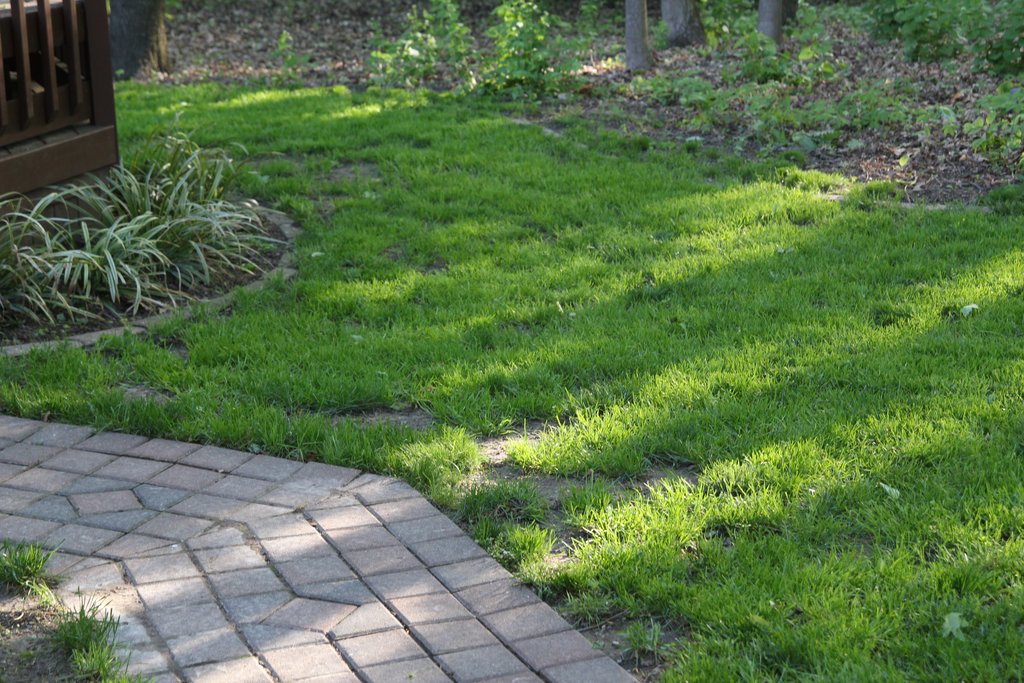
Ok, so I like grass. Soft, plush, green healthy grass. We have some in our yard, actually, one spot of grass that has probably had just the right amount of sun and shade to protect it from the summer heat and keep it healthy without much maintenance over the years. I always enjoyed mowing that part of the lawn and I wished the whole lawn were like it. A few years ago, it was probably a very nice lawn, but it wasn't any longer (at least to me). Like the rest of the gardens were when we moved in, the grass was thin in many spots and had various different types of grass present, and then crabgrass filled in the rest.
But even so, 2010 was a rough year on the lawn as it was for many lawns in the region. A lengthy
drought occurred starting in late July that didn't end until November. But to make matters worse, earlier in the year I had spilled fertilizer in several places that ended up killing the grass in several spots. And, we had grubs that killed some large sections of the lawn. Here is how it looked:
 |
| Count the robins. |
Note the thinned areas of dead grass, particularly the far right and the perimeter. Also, note the many robins feasting on the grubs. I count 15 in this photo. A few days later, there were over 40, but unfortunately they flew away before I could get a photo. Mmm... grubs! I'm glad they were happy, at least.
So, of course, I needed to do something, but what could I do? So, I started researching, first about grubs and then about repairing the grass. I quickly discovered the wonderfully informative
Purdue Turfgrass Program site and the many great
publications and subsequently started dreaming of a nice new lawn.
I found these
instructions for establishing turfgrass from seed. But, there was a problem: it was already September and nearing the end of the optimum time period for planting new grass (August 15 to September 15 in Central Indiana). So, I decided to act fast and to try to squeeze it in. In hindsight, I probably should have waited or at least not gone straight to the deep-end like I ended up doing.
So much to do and so little time, I went to the hardware store and purchased a manual tiller. I took a day off of work and went to work on the dead areas to prepare the soil for replanting. But, then I got a crazy idea: why not replant some of the grass that I don't like while I'm at it? I think I was blinded by my desire for nice lush grass, because I started digging up the "old" grass and this is not how that should typically be done. You're supposed to kill it all first, then remove it, but this process can take a week or two - time I didn't have, so I decided to "improvise."
Soon, after several hours, blisters upon blisters, and with my shoulder about ready to come out of its socket, I could till no more, and I was nowhere near done. I probably should have just stopped here, but instead I decided to go to the store and rent a large power tiller. This made the job much easier and in turn allowed me to rip up even more of the lawn. Foolishly, I didn't even think about the sprinkler heads scattered throughout the lawn that were part of the (disabled) sprinkler system until I hit one of them - and then another, and another. Not to mention any buried cables, which thankfully I didn't encounter.
I'm not quite sure what I was thinking with all of this. It was turning into a nightmare and there was no turning back. What I thought would take a day of work, ended up taking over a week, working every evening, sometimes into the night. My neighbors probably thought I was nuts. I was!
Once I finished tilling the soil, I had to remove all of the old grass that I tore up. This turned out to be a very difficult task. The tiller worked the grass all over the place, sometimes 6 inches down. I basically had to sift through it and pull it out, trying to keep as much of the soil in place as possible. This step took many evenings to complete.
At this point, I was getting closer. The next step according to the instructions I was trying to follow was:
The soil should be allowed to settle after tilling or compacted slightly with the tires of a tractor or other suitable implement. Heavy rains and/or irrigation will hasten settling. Allowing the soil to settle with prevent undulations and difficult mowing in the future.
Um, let's see, I had no tractor, no time to wait for rain (guess I probably could have irrigated, but I wanted to plant that day). In the end, I used a piece of peg board and stomped on it over all of the soil. Surprisingly, it looked pretty good, but will it end up even? I guess we'll see. And now, my neighbors officially knew I was nuts - really, who jumps on their lawn?
Next I raked it over and made it look even nicer. At this point, I was pretty happy with how it all had turned out. Now it was time to seed it. But uh oh, what seed should I use? I was no expert, but had researched a little and knew that Bluegrass is the type of grass that I like, so I went to the store and bought a bag of Scotts Bluegrass mix:
 |
| Scotts Kentucky Bluegrass Mix |
 |
29.43% Abbey Kentucky Bluegrass
13.26% Courtyard Kentucky Bluegrass
5.05% Thermal Blue Kentucky Bluegrass
50% Water Smart Coating |
In hindsight, doing more grass seed research would have been beneficial. There are many varieties of bluegrass grass, some better and more advanced than others. While the kind I used will probably be just fine, I also probably could have done better. The
National Turfgrass Evaluation Program is a great resource for researching different varieties for various locations. I'm still baffled by all of the different types.
For mulch, I also purchased a bag of GreenView Grass Seed Accelerator:
 |
| GreenView Grass Seed Accelerator |
 |
| 0.7 - 1.1 - 0.4 |
With these two products, I made two mistakes:
- I didn't plant enough seed
- Since the mulch had fertilizer in it, I didn't fertilize
The seeding rate was probably the biggest mistake because I only put down about half of the bag of seed (approximately 1.5 lbs). What threw me off is the 50% coating. The experts said to put down 1.5-2 lbs of seed per 1000 sq. ft. Since I was working with roughly 1000 sq. ft., I figured half the bag would be about right. Well, I forgot that half of the bag was actually the coating on the seeds! So, instead of putting about 1.5 lbs. or so down, I only put roughly half that. Unfortunately, I didn't realize this until several weeks later when the grass started to germinate and I noticed that it looked rather thin. As soon as I could, I planted the rest of the bag hoping it would have enough time to become established before winter.
The second mistake I made was to use the mulch as the fertilizer. I failed to actually look at the bag and see how much fertilizer it had in it: 0.7-1.1-0.4 - not much at all; certainly nowhere close to the recommended 1.5 lb of Phosphorus per 1000 sq. ft. So, essentially, I didn't fertilize. This may or may not have been a big issue because I didn't do a soil test.
This is what it looked like after it was all said and "done" (with half the seed on at the time of this photo):
 |
| September 11, 2010 : After the seed was planted and the first watering. |
I watered as frequently as I could, which ended up being two times a day: once in the morning and once in the evening. Eventually, after about 2 weeks, the grass started to grow. It grew very slowly and never very tall. I know that bluegrass is not very quick to establish, but I wonder if it could also have been impacted by not having much Phosphorus, or some other factor.
As soon as the first blades were roughly 2" tall, I followed the instructions to mow at 1.5" for the first few times. It was strange to be stepping on the grass when it was so new, but it seemed to be ok. It never grew much taller than that, though. After about 4 weeks, I applied about 0.75 Nitrogen and then again 8 weeks after germination. Thankfully, temperatures stayed fairly warm late into the fall giving more time for the grass to grow. Also, after about three weeks of twice daily waterings, I caved in and called someone out to take a look at the irrigation system to see how much it would take to get it working. Several hundred dollars later, I was a very happy man.
After a much needed winter's rest (for me!), here is how it looks now:
 |
| March 2010 |
This is only showing the top left side of the before photo and from a different angle - not the greatest before/after sequence, but it shows that something grew there - it wasn't a complete flop!
However, there are still several potential issues to contend with:
- It still isn't very thick and in some places, particularly near the edges of the existing grass, there are even bare spots.
- It is still pretty short, and the edge of the existing grass is very evident since it's much taller.
- There are quite a number of weeds.
It'll be interesting to see what happens once it starts growing again this spring when temperatures get warmer. Will it fill in and thicken up? Will it grow taller? Will it grow at a comparable speed to the existing grass? Will the weeds be overcome? We'll see.
I'll have another post on the weed problem soon.